About 60 milesAround 600 feet · Borrego Springs
Rust-red animals on the Borrego plain
Well over a hundred steel sculptures stand on open desert around Borrego Springs: camels, mammoths, sabertooth cats and a serpent that seems to swim under the road.
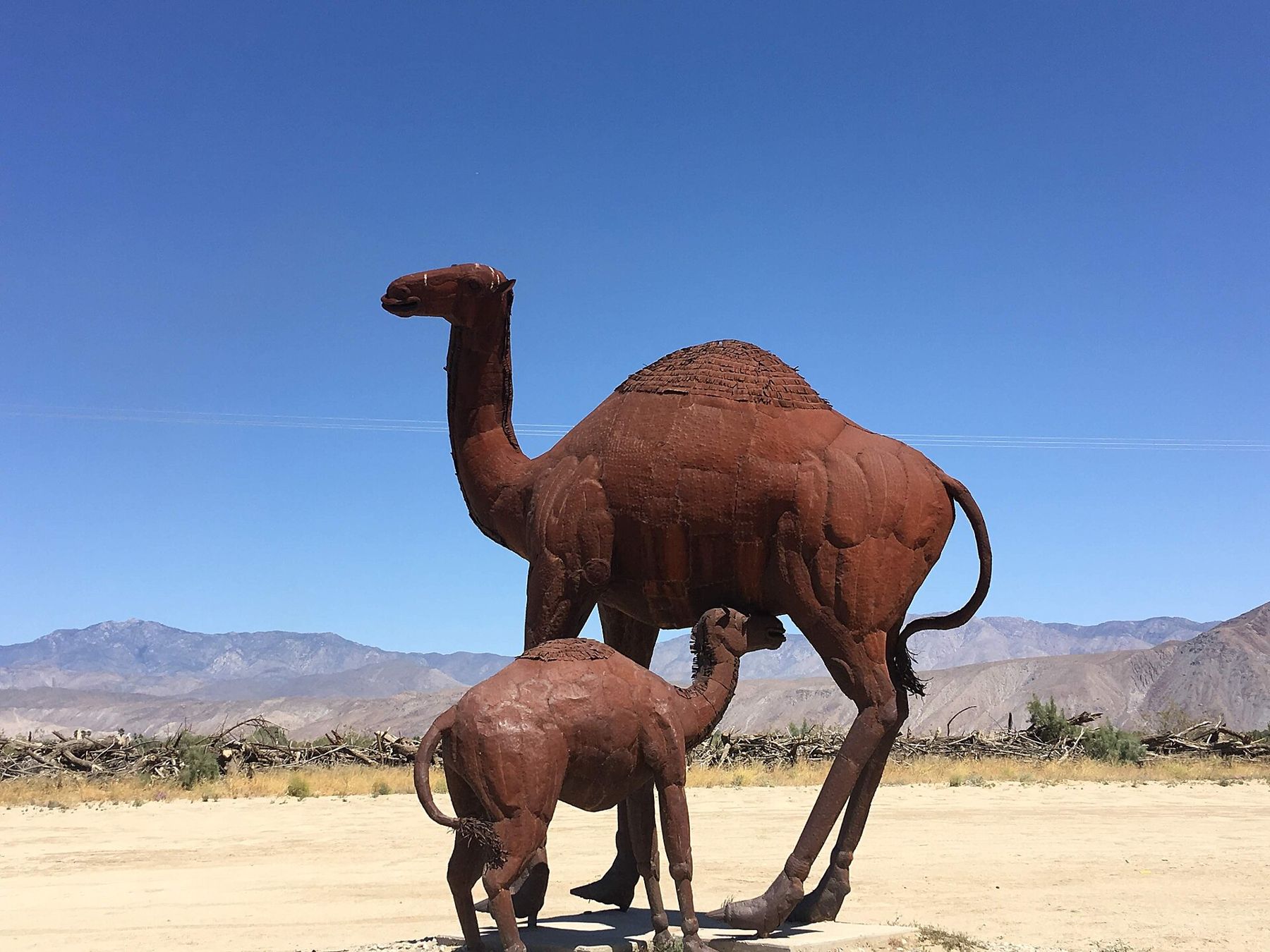
Drive into Borrego Springs from almost any direction and something large and rust-coloured appears off to the side of the road. It might be a camel nursing its calf, a ground sloth reaching for a branch that is not there, or a mammoth with curled tusks standing in the creosote. These are the metal animals of Galleta Meadows, well over a hundred steel sculptures scattered across open land around the town.
They stand on private land that the owners have left open to the public, with no gate and no ticket. You park on the dirt, walk up, and look. The setting does as much work as the steel: bare mountains on three sides, a pale valley floor, and a sky that is usually cloudless from autumn to spring.
Animals that once walked this valley
Most of the figures are not invented. They are modelled on animals whose bones have been found in the badlands east of town, where layers of old lake and river sediment hold one of the richest fossil records in North America. Millions of years ago this valley was greener, with grassland, streams and trees, and the animals that lived here would surprise anyone who knows the desert only as it is now.
- Camels and early horses, both native to North America long before they disappeared from it.
- Mammoths and gomphotheres, elephant relatives with very different tusks.
- Sabertooth cats, giant ground sloths and large birds of prey.
- Smaller desert creatures in giant size, among them a scorpion and a grasshopper.
Mixed in among them are figures from more recent history and from pure imagination, the famous serpent above all. Each sculpture is built from welded sheet steel over a frame, and the surface weathers to a rich brown that changes colour through the day.
If the fossils catch your interest, the state park visitor center west of town covers the valley's natural history, and the badlands where many of the bones were found are on view from Font's Point, the overlook above the Borrego Badlands.
The serpent that crosses the road
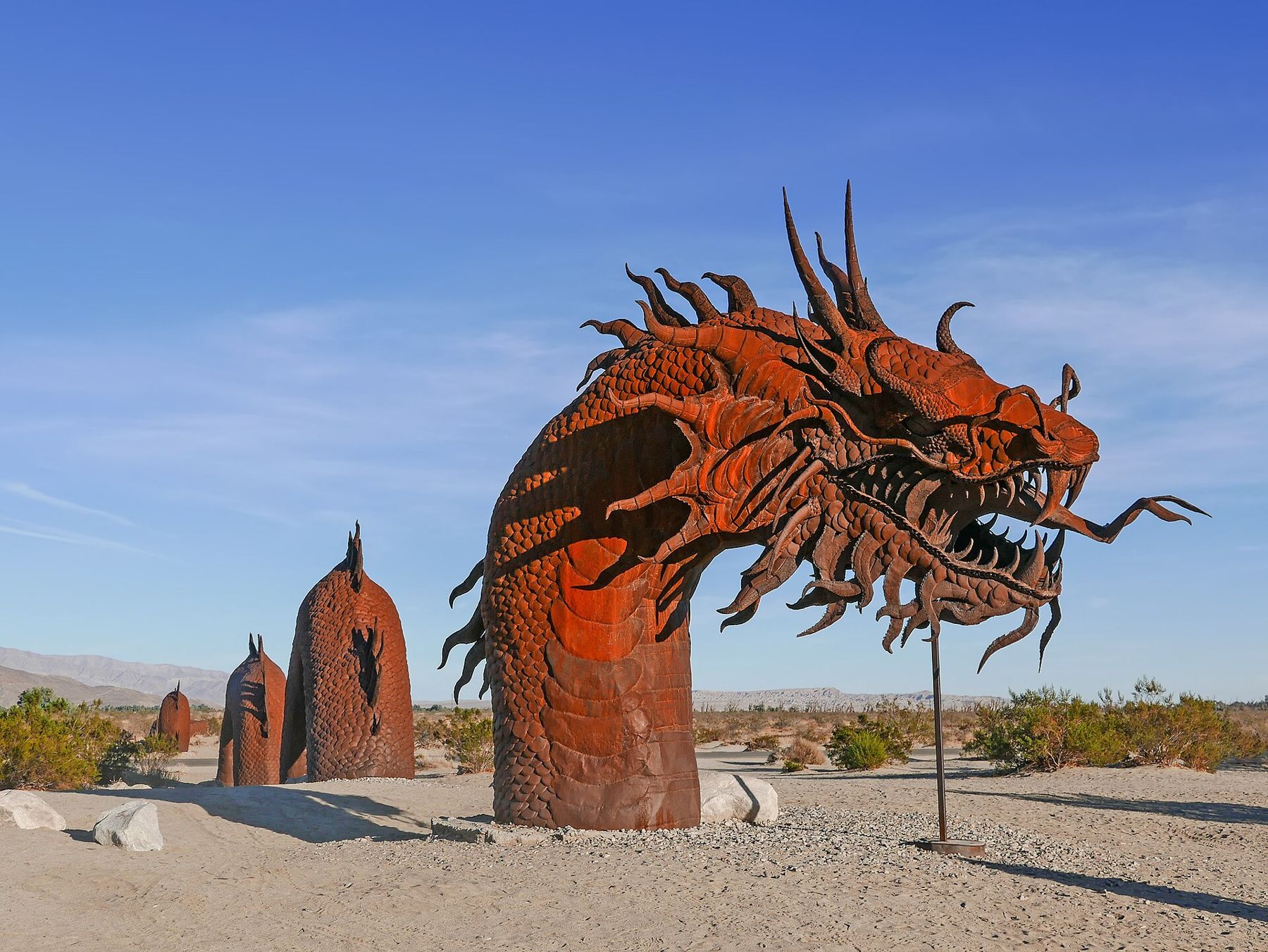
The single best-known piece is the serpent, a long scaled creature with a dragon-like head, horns and open jaws. Its body rises out of the sand in a row of humps, appears to dive under Borrego Springs Road, and comes up again on the far side with a curled tail. It sits north of Christmas Circle, the roundabout at the centre of town, and you will see cars pulled over beside it most mornings in season.
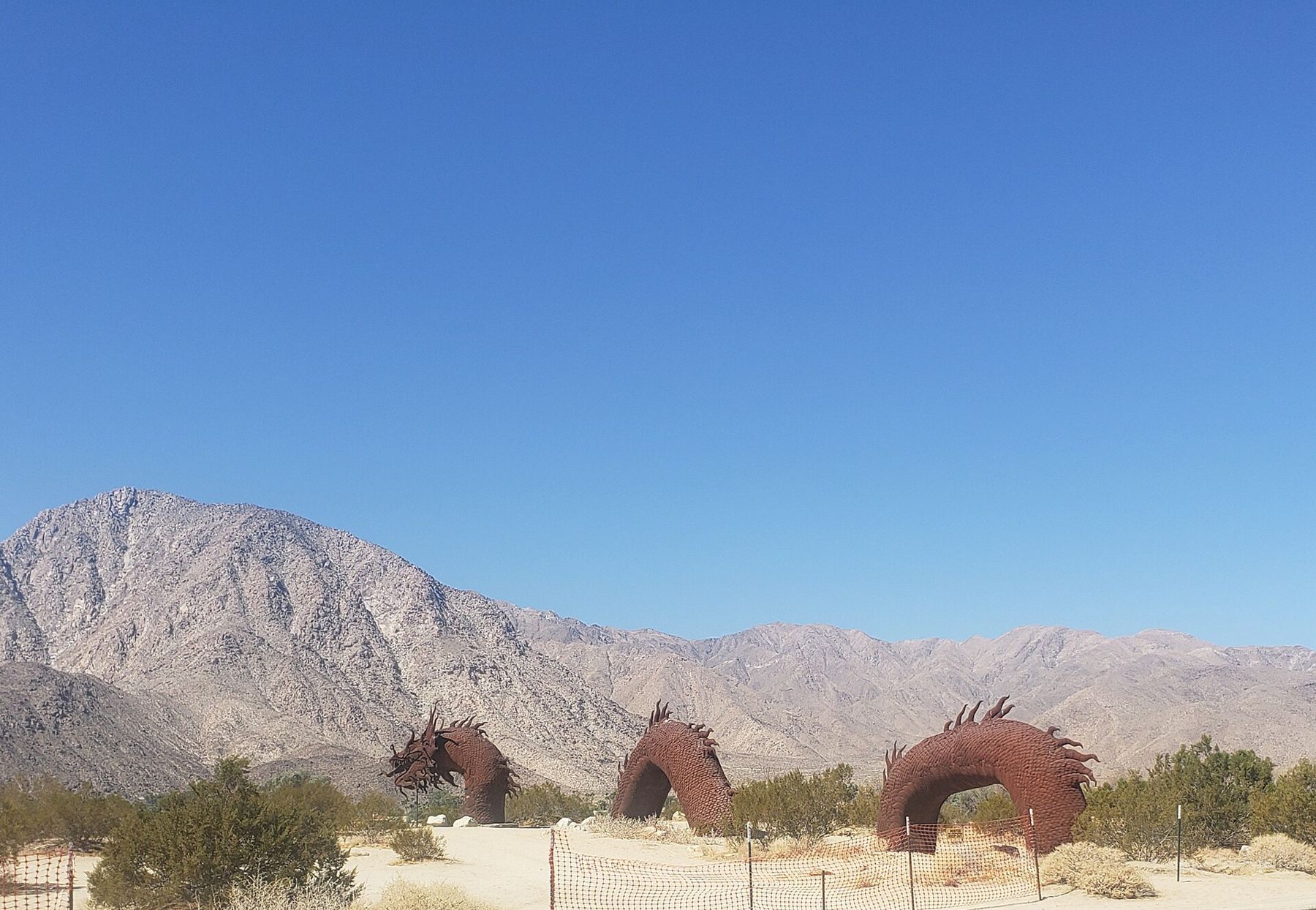
Walk the length of it rather than stopping at the head. From the tail end you get the whole curve with the mountains behind, and the low sun picks out the rows of scales. Stay off the sculpture itself; climbing damages the welds and the edges of the steel are sharp.
 About 70 miles · Around 600 feetDark nights in Borrego Springs
Finding the clusters
The sculptures are spread out rather than gathered in one field, so a visit is a slow drive with frequent stops. Several groups stand along Borrego Springs Road north of Christmas Circle and along Henderson Canyon Road, which runs east and west across the north end of the valley. Others are east of town and to the south along the road toward Highway 78. A full loop of the main groups takes a couple of hours at an easy pace.
Printed maps of the locations are often available in town and at the park visitor center, and they are worth having because new pieces have been added over the years and phone coverage on the valley floor can be patchy. Some figures are visible from the pavement; others sit a few hundred yards back along dirt tracks.
Parking on the dirt
Most stops are simple dirt pull-offs. Before you leave the pavement, look at the surface. Firm, packed ground is fine for an ordinary car, but some tracks turn to loose sand within a few yards, and a sedan can dig itself in quickly. If the track looks soft, park on the shoulder and walk in. Never block the road or a driveway, and keep to existing tracks so the desert plants between the sculptures survive.
Heat, light and the right hour
The valley floor sits at only a few hundred feet above sea level, and it is hot for much of the year. From late spring to early autumn, temperatures well over 100 degrees are common by midday, and there is almost no shade near the sculptures. Steel in full sun becomes too hot to touch.
The season for this drive runs roughly from October to April. Even then, start early. The first hour after sunrise is the best time for both comfort and photographs: the steel glows orange, long shadows give the animals depth, and the mountains behind are still soft and blue. Late afternoon is the second choice, when the light comes back warm from the west.
Carry more water than seems sensible, even for a short loop, and wear a hat and closed shoes. Rattlesnakes are active in the warmer months and rest in the shade of shrubs, so watch where you step when you leave the track.
Respecting open land
That the sculptures can be visited at all depends on visitors treating the land well. The figures stand on private property that is open by permission, not a park with rangers on patrol. A few simple habits keep it that way:
- Walk around the sculptures; do not climb, hang from or sit on them.
- Take all rubbish away with you, including fruit peel, which takes a long time to break down in dry air.
- Drive only on existing tracks and never across open ground.
- Keep dogs on a leash and away from the bases.
Drones, events and commercial shoots may have their own rules, so check before you plan anything beyond a quiet walk.
Pairing the drive with the rest of the valley
The sculpture loop fits easily into a day in the valley. A morning on the trail to the oasis in Palm Canyon and its fan palms can be followed by a slow drive past the animals once the trail grows warm. In a wet spring the same roads lead through the flower fields described in the wildflower years of the Anza-Borrego desert, and Henderson Canyon Road is often one of the first places colour shows.
Some visitors come back after dark. Borrego Springs keeps its lighting low, and the shapes of the animals against a sky full of stars are a strange and quiet sight. Use a red light, keep to the pavement and pull-offs you saw in daylight, and remember that the desert cools sharply after sunset in winter.
Whatever the hour, the animals are best taken slowly. Stand back, let the mountains fill the space around them, and imagine the valley when real camels and mammoths grazed it.